

History and curiosities of the Roman Colosseum
The Colosseum has stood at the heart of Rome for almost two thousand years, but its current appearance is the result of centuries of construction, spectacles, transformations and restorations. Before becoming a monumental ruin, it was the largest amphitheatre in the Roman world and one of the settings from which emperors projected their power before the population.Knowing its history helps to better interpret what still remains: the arches of the façade, the arrangement of the seating areas, the Arena and the network of the hypogeum. If you want to see these spaces during your trip, you can check the available options and book your Colosseum tickets.
The origin of the Flavian Amphitheatre
The original name of the Colosseum was the Flavian Amphitheatre, in reference to the dynasty that promoted its construction. It was built in the valley between the Palatine, Esquiline and Caelian hills, on part of the land that Nero had incorporated into his imperial residence, the Domus Aurea.
In that area there was an artificial lake associated with Nero's palace. After his death and the civil wars of the year 69, Vespasian returned this space to public use and promoted the construction of a large permanent amphitheatre. The choice of location had a strong political significance: an area reserved by an emperor became a venue for spectacles intended for the community.
The construction of the Colosseum
Vespasian, Titus and Domitian
Vespasian began construction around 70 AD, although he did not live to see the building completed. His son Titus inaugurated the amphitheatre in the year 80 with prolonged games that ancient sources describe as extraordinary. Domitian later completed the upper levels and promoted the development of the hypogeum, the system of spaces located beneath the Arena.
The involvement of three emperors explains why the building is known as the Flavian Amphitheatre. Its construction was rapid considering the scale of the project, but there is no solid historical basis for repeating the claim that 100,000 slaves worked on it, a figure frequently found in popular content that cannot be considered proven.
Construction materials and techniques
The Colosseum combines travertine pillars and blocks with tuff, brick, Roman concrete and marble. The combination of materials made it possible to create a resistant structure while also organising galleries, stairways and corridors capable of distributing tens of thousands of people.
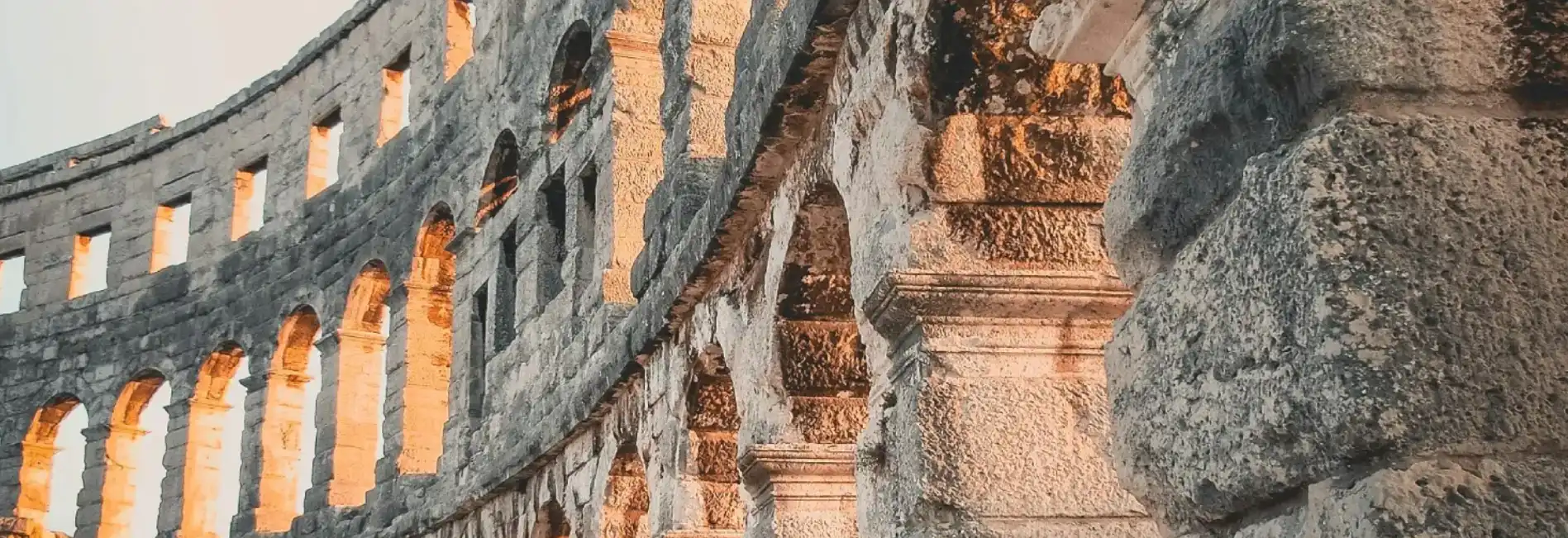
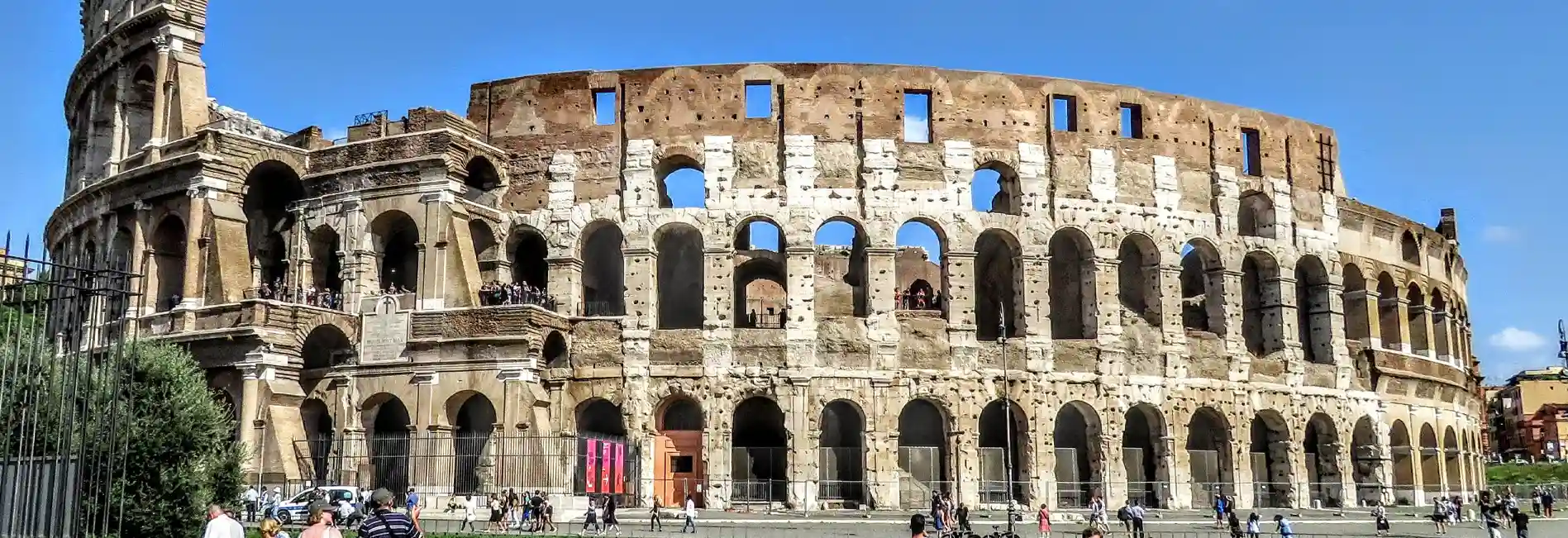
The blocks of the façade were joined using metal clamps. Many were removed in later periods, leaving the holes that can still be seen in the stone. The different superimposed orders of columns and the succession of arcades gave the exterior its monumental rhythm. You can identify these elements in the guide on what to see at the Colosseum, Roman Forum and Palatine Hill.
The spectacles of the Colosseum
The amphitheatre hosted celebrations financed by the emperor or members of the elite. The spectacles served as collective entertainment and as a public demonstration of power, wealth and organisational capacity. The Arena could be transformed with sets and mechanisms to represent very different scenes.
Gladiator fights
The munera, or gladiator fights, were the spectacles most closely associated with the Colosseum. Participants used different equipment and fighting styles, and the confrontations followed rules. Not every fight necessarily ended with the death of one of the gladiators, as their training was costly and some became highly popular.
Animal hunts
The venationes pitted specialised hunters against animals brought from different territories of the Empire. Lions, leopards, bears and other species appeared in settings that could evoke natural landscapes. Transporting animals to Rome and making them appear suddenly in the Arena demonstrated the territorial reach and resources of the Empire.
Executions and performances
The programme could also include public executions and re-enactments inspired by mythological stories or historical episodes. Some punishments were incorporated into staged performances before the spectators. Violence formed part of the political and social language of these spectacles, which was very different from the contemporary understanding of public entertainment.
How the Colosseum worked
The Arena and the hypogeum
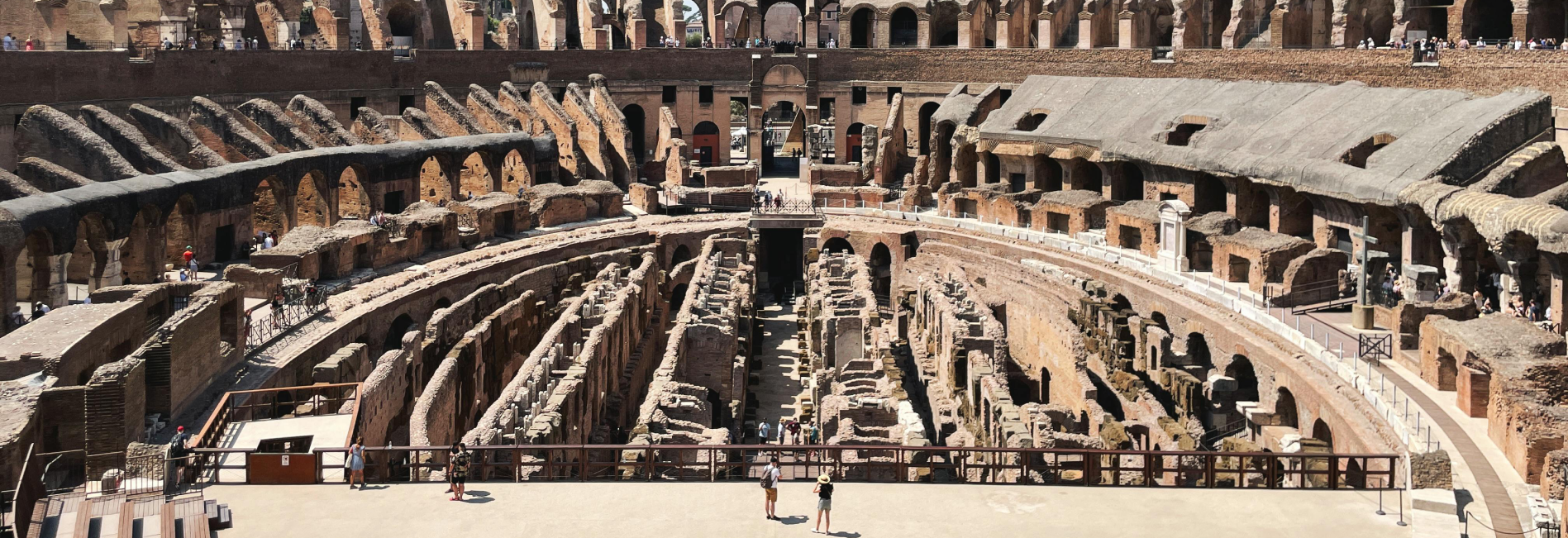
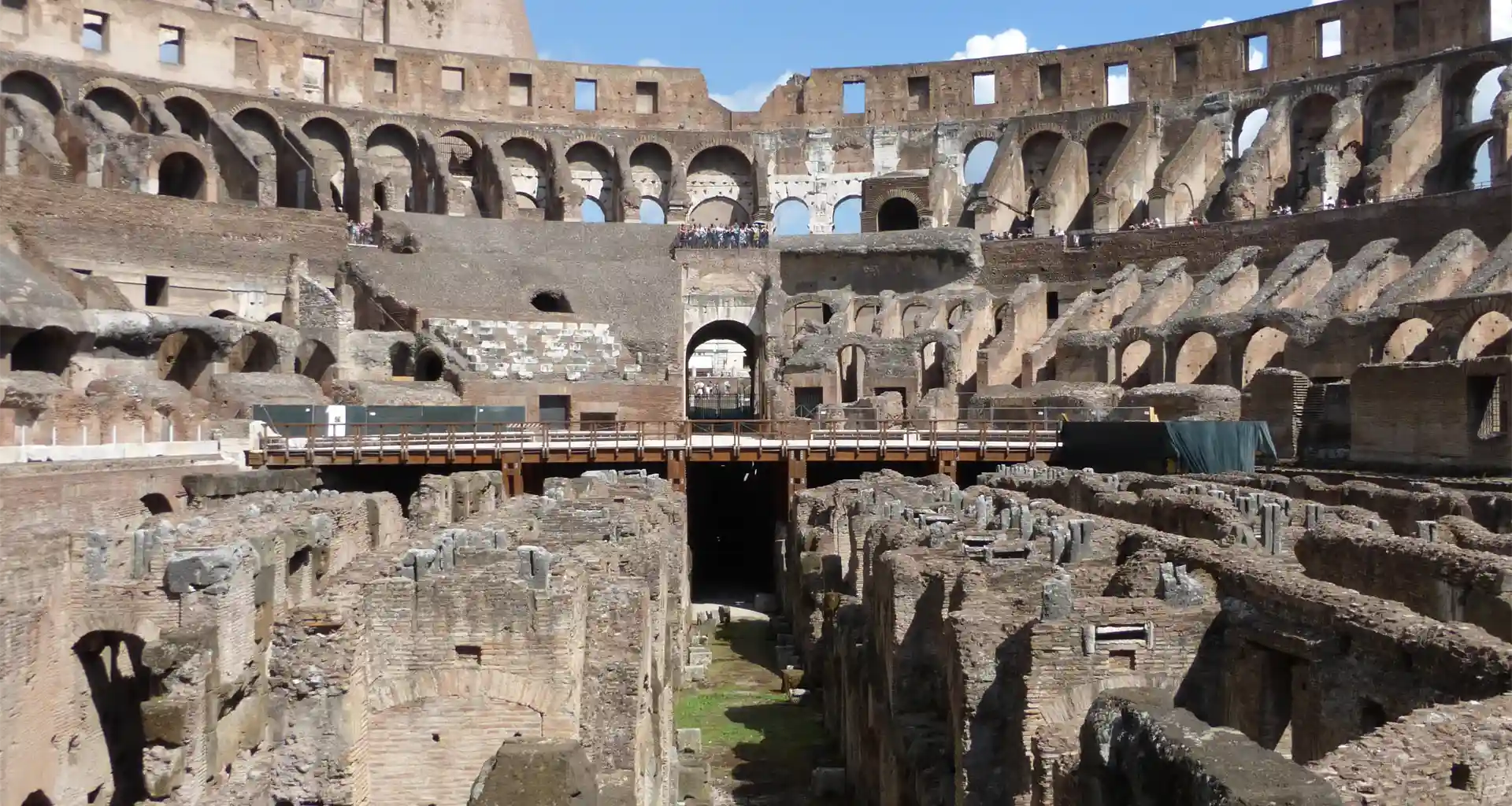
The Arena was a wooden platform covered with sand. Beneath it extended the hypogeum, made up of corridors, chambers, cages and service areas. Trapdoors, lifts and stage mechanisms made it possible for people, animals and scenery to appear before the audience.
The underground system was developed especially under Domitian and shaped the later operation of the amphitheatre. The disappearance of much of the flooring makes it possible to see it from above, although the Arena and the Underground are different areas and current access depends on the type of visit.
The velarium
Above the seating areas, the velarium could be extended, a large system of awnings supported by masts, ropes and anchors. Its main purpose was to provide shade for part of the audience. Its operation required specialised personnel and precise coordination, as shown by the supports preserved at the top of the building.
Entrances and audience distribution
The perimeter originally had 80 entrance arches and a complex network of galleries and stairways. Entrances and sections were organised to guide each spectator to their designated area. This circulation separated the routes and facilitated the movement of a very large crowd.
The location of the seating reflected Roman hierarchy. Authorities and privileged groups occupied positions closest to the Arena, while the upper sections were reserved for lower-ranking categories. The building transformed Rome's social structure into a visible distribution of the audience.
The decline and transformation of the monument
Earthquakes, looting and reuse of materials
Gladiatorial games ceased in the 5th century, while animal hunts continued for some time longer. Without its original function, the building began a long transformation. During the Middle Ages it housed dwellings, workshops, warehouses and spaces associated with different groups and institutions; it was also incorporated into fortified structures.
Fires and earthquakes damaged the structure, and the collapse of part of the southern façade changed its silhouette forever. Travertine blocks, marble and metal elements were reused in other buildings in Rome. For centuries, the Colosseum served as a source of building materials, before its protection as a monument was consolidated.
From amphitheatre to symbol of Rome
The association of the building with Christian tradition, the interest of artists and travellers and the development of archaeology gradually changed the way it was viewed. From the 18th and 19th centuries onwards, excavations, consolidation work and restorations followed one another. The ruin ceased to be seen as a reusable space and came to be recognised as an exceptional testimony to Antiquity.
Today the monument continues to be the subject of research and conservation. To prepare your visit while taking into account its entrances and accessible areas, see our guide on how to visit the Colosseum.
Curiosities about the Roman Colosseum
Why it is called the Colosseum
The term Colosseum does not come from its dimensions, even though the building is colossal. The most widely accepted explanation links it to the Colossus of Nero, an enormous statue that stood nearby. Over time, the name associated with the statue came to identify the amphitheatre.
How many people could fit in the Colosseum
Estimates vary because the entire cavea has not survived and the sources do not provide a single figure. The most cautious estimate places the capacity at around 50,000 spectators, rather than presenting as certain the figure of 80,000 that frequently appears in popular texts.
Naval battles: what is really known
Ancient authors mention aquatic spectacles associated with the inauguration of the amphitheatre. However, specialists debate whether these performances took place inside the Colosseum and how the Arena could have been flooded before the definitive construction of the hypogeum. Therefore, it is not advisable to state that large naval battles were fought there as a fully proven fact.
The social organisation of the seating areas
Seats could not be chosen freely. The cavea was divided according to the rank, gender and social status of the attendees. Proximity to the Arena expressed prestige, while the highest areas offered a more distant position to groups of lower status.
The Colosseum as a World Heritage Site
The Colosseum was not inscribed separately on the World Heritage List. It forms part of the Historic Centre of Rome, recognised by UNESCO in 1980 and subsequently extended. This distinction helps explain that its value is also linked to the urban and archaeological landscape surrounding it.
Its history connects imperial Rome with the medieval, modern and contemporary city. After learning about its evolution, you can relate it to other major sites in the capital in Colosseum, Pantheon and Vatican Museums: how to organise your visits in Rome.